

 See My Latest Article on HelloNation
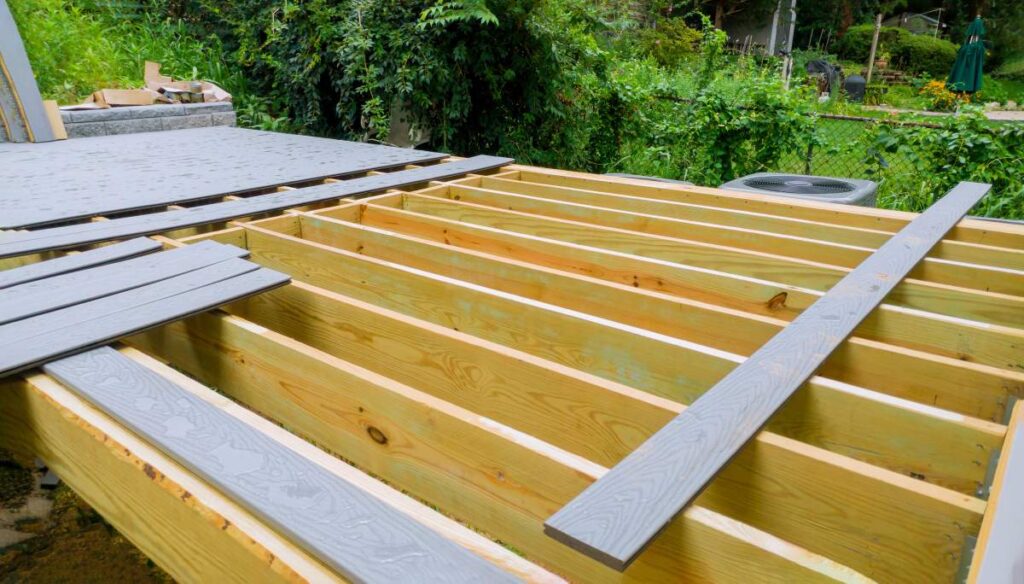
A deck can look worn without being structurally unsafe, while a deck with fresh-looking boards may still have serious problems underneath. For homeowners in Knoxville, TN, the decision between renovation and complete replacement should begin with the condition of the framing, footings, connections, stairs, and guardrails—not the appearance of the surface alone.
What is the difference between deck renovation and replacement?
Deck renovation keeps the main structural framework and improves selected components. Complete replacement removes most or all of the existing deck and builds a new structure, often with a different layout or materials.
Renovation may include:
- Replacing damaged decking boards
- Installing new railings or stairs
- Adding flashing where the deck meets the house
- Repairing or reinforcing joists and beams
- Replacing fasteners, post connections, or hardware
- Cleaning, staining, or sealing sound wood
- Improving drainage and airflow beneath the deck
Replacement is more appropriate when the underlying structure has widespread decay, movement, poor connections, inadequate footings, or a layout that no longer meets the household’s needs.
The visible deck boards are only the walking surface. They do not reveal whether the ledger board is securely attached, whether posts are bearing properly, or whether water has damaged the framing.
When is renovation usually enough?
Renovation may make sense when the deck has a sound structural foundation and the damage is limited to specific areas. For example, a deck with weathered boards but solid joists, stable posts, and properly connected beams may need resurfacing rather than demolition.
Signs that support a renovation approach include:
- Most framing members are firm and free of soft spots
- Posts remain plumb and do not shift when the deck is loaded
- Beams and joists are not significantly sagging or twisting
- The deck feels stable while people walk across it
- Stairs are securely attached and have consistent riser heights
- Railings are firmly connected and do not wobble
- Water is not collecting against the house or under the structure
- Damage is limited to a few boards, steps, or rail sections
A useful test is to examine areas that stay damp, especially where boards overlap joists, where posts meet the ground, and where the deck connects to the house. Surface discoloration alone is not proof of structural failure, but soft wood that can be easily penetrated with a screwdriver deserves closer attention.
What conditions point toward complete replacement?
Replacement becomes more reasonable when problems affect the deck’s primary support system. Structural repairs can sometimes extend the life of an older deck, but piecemeal work is less practical when multiple parts are failing at the same time.
Common replacement indicators include:
- Widespread rot in joists, beams, posts, or the ledger board
- Noticeable bouncing, swaying, leaning, or settlement
- Repeatedly loose connections or pulled-out fasteners
- Cracked or undersized support members
- Footings that have shifted, settled, or been undermined by water
- Stairs that cannot be safely reinforced
- Guardrails that are too low, widely spaced, or poorly attached
- A deck attached without adequate flashing or separation from the siding
- Extensive mold, decay, or insect damage in the framing
- A design that cannot accommodate needed repairs without major reconstruction
A deck does not need to look severely damaged to have a serious ledger or connection problem. The area where the deck meets the house is particularly important because moisture can enter behind siding or trim and damage both the deck and the house wall.
How does Knoxville’s climate affect the decision?
Knoxville’s combination of substantial annual rainfall, humid summers, occasional freezing conditions, and seasonal temperature changes can accelerate moisture-related deterioration. Decks that dry slowly, sit beneath dense shade, or have poor drainage are more vulnerable to rot and fastener corrosion.
Local conditions make several details especially important:
- Keep leaves, soil, and debris from collecting around posts and under stairs.
- Look for water trapped against the house or beneath impermeable decking.
- Inspect end cuts and exposed wood grain, which absorb moisture readily.
- Check whether splashback from roofs or downspouts repeatedly wets the framing.
- Watch for frost-related movement around footings and stairs.
- Allow air to circulate beneath the deck instead of enclosing damp areas.
A deck that receives strong sun may experience surface checking and fading, while a shaded deck may develop persistent dampness. Neither condition alone determines whether the deck must be replaced. The deciding issue is whether the structure can be made sound and kept dry.
Is replacing the boards the same as rebuilding the deck?
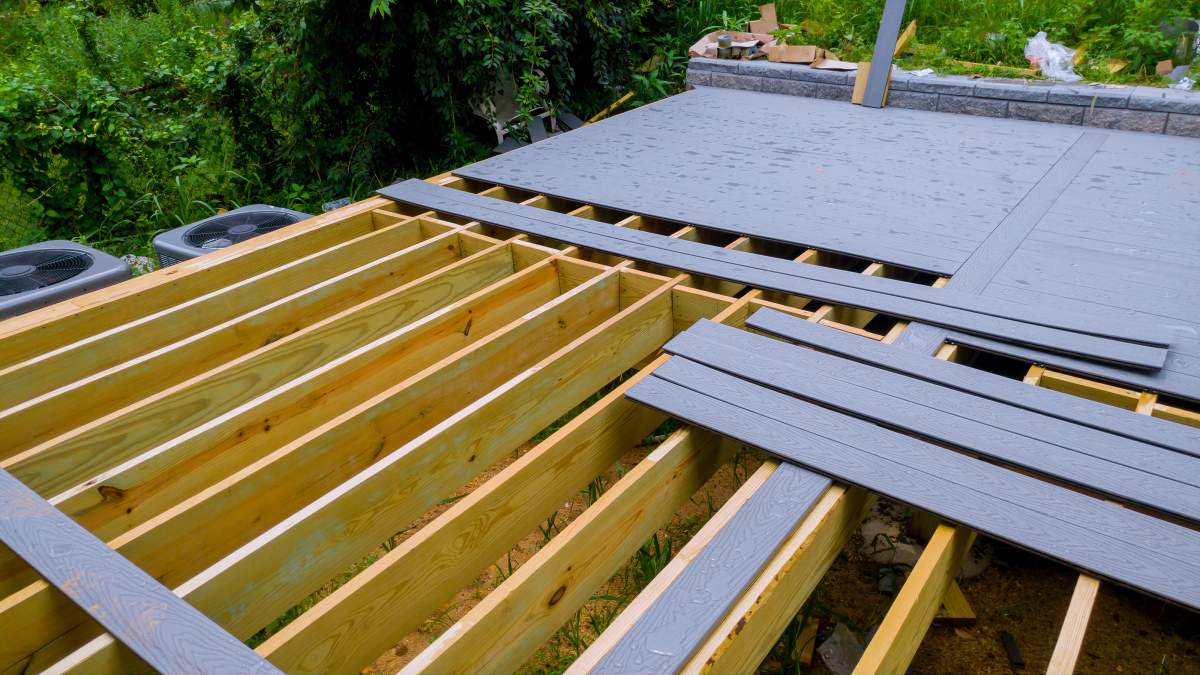
No. Replacing decking boards changes the walking surface but does not correct hidden framing or connection problems.
New boards can temporarily improve appearance while leaving behind:
- Decayed joists
- Inadequate beam-to-post connections
- Missing flashing
- Weak stair supports
- Loose ledger attachments
- Unstable footings
Before resurfacing, each framing member should be checked where moisture is most likely to remain. If large sections of framing are damaged, installing new boards over them can make future repairs harder and increase the risk of relying on a structure that is not adequately supported.
Which option offers more design flexibility?
Complete replacement generally offers more flexibility because the layout can be reconsidered from the beginning. This may allow changes to deck size, stair location, privacy features, seating areas, lighting, drainage, or access from the house.
Renovation can still include meaningful improvements, but existing posts, stairs, and support locations may limit the design. A household that wants only a safer walking surface may not need a new layout. A household that wants to change the deck’s footprint or add substantial weight may need a structural redesign rather than surface work.
Adding a roof, hot tub, masonry feature, large built-in bench, or enclosed section can create loads that an older deck was never designed to support.
Do permits matter for renovation or replacement?
They can. Within Knoxville, residential construction, alteration, repair, enlargement, or replacement work may require a building permit unless a specific code exemption applies. A project that changes the structure, footprint, stairs, guards, or attachment to the house should not be treated as ordinary maintenance without checking the applicable requirements.
Permit review may involve structural plans, setbacks, property conditions, inspections, and compliance with residential building codes. Requirements can also differ based on whether the property is inside city limits, so the project location should be confirmed before work begins.
Permit questions are especially important when replacing footings, changing the deck size, rebuilding stairs, attaching a deck to the house, or modifying guardrails.
How should a homeowner compare the cost?
Renovation usually costs less when the structure is sound and the work is limited. However, a low initial cost may not be economical if repairs keep uncovering additional deterioration.
Compare the options by considering:
- How much framing can remain safely in place
- Whether footings and attachment points are adequate
- The age and condition of the stairs and railings
- The expected service life of the replacement materials
- Drainage and moisture problems that must be corrected
- Whether the current layout still works
- Permit, inspection, demolition, and disposal requirements
- The likelihood of needing more repairs soon
The most useful comparison is not simply “repair price versus replacement price.” It is the expected cost and reliability of the deck over the next several years.
A practical decision rule
Renovate when the structure is fundamentally sound and the problems are localized. Replace when deterioration is widespread, the support system is unreliable, or the deck no longer fits the property’s needs.
Any deck that moves noticeably, has a soft ledger or beam, shows major post decay, or has unstable stairs should be treated as a safety concern rather than a cosmetic project. Structural uncertainty, elevated work, electrical changes, and permit compliance are situations where qualified assistance may be necessary before work proceeds.